

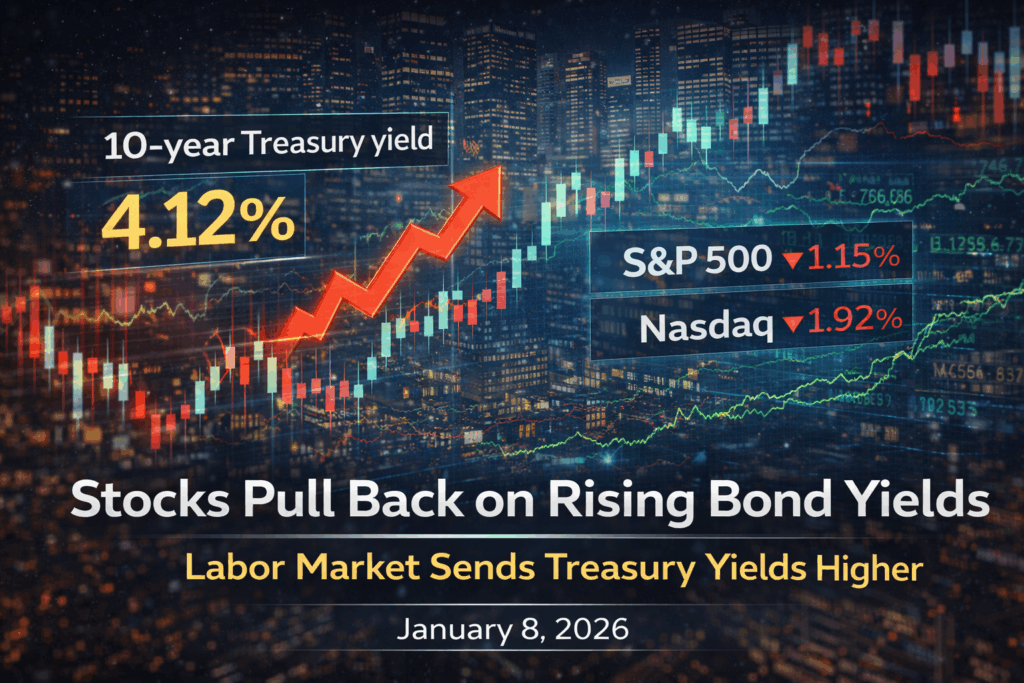
U.S. equity markets retreated on Thursday after stronger-than-expected labor market data pushed Treasury yields higher, renewing debate over the timing of potential interest rate cuts in 2026.
The latest employment report showed continued job creation momentum and steady wage growth, reinforcing the view that the economy remains resilient despite tighter financial conditions over the past year.
The S&P 500 declined modestly in early trading, while the Nasdaq Composite experienced sharper losses as growth stocks reacted to the uptick in yields. The Dow Jones Industrial Average proved relatively stable, supported by gains in industrial and energy sectors.
Bond Market Reaction
The 10-year U.S. Treasury yield climbed following the report, reflecting expectations that the Federal Reserve may maintain its current policy stance longer than previously anticipated.
Higher yields tend to weigh on technology and other high-growth sectors due to valuation sensitivity. As a result, AI and semiconductor stocks led the pullback after strong gains in late December.
Sector Performance
Technology: Under pressure amid rising yields Financials: Supported by higher rate expectations Energy: Benefited from stable oil prices Utilities: Saw mild defensive inflows
Market Interpretation
Investors are now recalibrating expectations for potential rate cuts later this year. While inflation has moderated compared to 2024 levels, a resilient labor market may delay policy easing.
Analysts note that short-term volatility is typical during transitions between monetary policy phases. Markets often reassess positioning after each major macroeconomic release in early January.
What Comes Next
Key data to watch in the coming weeks includes:
Updated inflation figures Retail sales performance Corporate earnings season beginning later this month Federal Reserve commentary from upcoming public appearances
Outlook
Despite the pullback, broader market trends remain constructive as long as economic growth continues and inflation stays contained. Investors appear cautious but not alarmed, with portfolio adjustments reflecting tactical shifts rather than broad risk-off sentiment.
As 2026 unfolds, the interplay between labor strength, inflation moderation, and central bank decisions will likely define the first quarter’s direction.